Pages

July 9, 2010

Welcome!

Welcome to the official blog of the Historical Society of Quincy and Adams County. It's been around for only a couple days, but this is what you'd call the initial public offering. Check out the earlier posts, and keep coming back for plenty more - including information about HSQAC events and anything else history related that's going on...

Contributions and help from the public are more than welcome here. If you have any old photographs related to the history of Quincy and Adams County, that you'd like to share... Please email them to meprovine@yahoo.com, along with all the details, and I'll get them on.

Adams County Map, 1875

Riverview Park Observatory

Riverview Park Observatory in Quincy, circa 1900.

Looking up towards Riverview Park.


Roy Brocksmith

A veteran of the stage and screen, Roy Brocksmith was born in Quincy on September 15, 1945. A multi-talented entertainer, after graduating from Quincy College, Roy moved to New York to perform on Broadway - before moving to Hollywood starting his career as a character actor in the late 70's. Noted for his appearance in TOTAL RECALL, Brocksmith’s other films include ARACHNOPHOBIA, THE ROAD TO WELLVILLE and the Coen Brothers film THE HUDSUCKER PROXY. He also appeared in numerous television shows, such as "Star Trek: The Next Generation", "L.A. Law," and was a regular on the CBS series "Picket Fences" from 1992 to 1996. In the course of his acting career, Roy had small but memorable roles in 35 films, and over two dozen TV shows. He passed away in 2001.

Read Roy's IMDb profile and his bio at Stark Trek's Memory Alpha.


Commercial from the 1990 Arnold Schwarzenegger sci-fi hit, TOTAL RECALL:

July 8, 2010

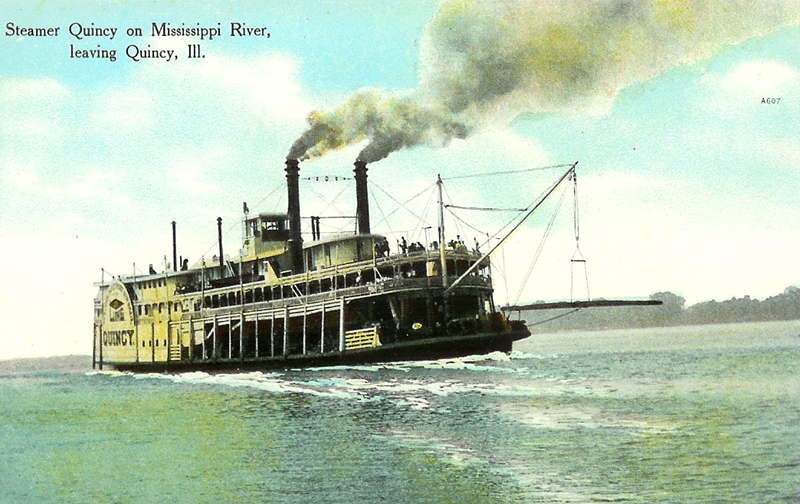
Steamer Quincy

This is a small collection of images of the Steamer Quincy, harvested from various sites around the internet. Most of the photos and vintage postcards depict the vessel in 1911.

Special thanks to Scott K. Williams of Florissant, MO and his site, stlouistimeportal.com, where I got this information, and most of the pictures. A cool site worth checking out.

The steamboat Quincy at the St. Louis riverfront, postmarked 1911. This is at least the fourth steamboat by the name Quincy. The vessel was built in 1896 at Dubuque, IA and ran the Diamond Jo Line from St. Louis to St. Paul, MN.

The Quincy sunk in the Mississippi River in July 1906 near Trempeleau Mountain, WI. But that was not the end. The ship was raised and continued to serve through 1917. She was raised reequipped with new boilers, extra guest rooms were added and in 1911 ran from St. Louis to New Orleans. Her last run was in 1917. The Quincy was the last side-wheeler in the St. Louis-New Orleans route.

Give to the Historical Society

The Society's mission is to provide for the education of its members and others about the history of Quincy, Adams County, and the surrounding area. The Society is committed to the collection and preservation of documents and other physical objects related to local history. Preserving and maintaining the Governor John Wood Mansion as a historic and architectural structure is a key priority of the Society. We also maintain The History Museum and an 1835 pioneer log cabin. The Visitors Center houses the Society's office and library as well as Quincy's History Shop. The Society offers Candlelight Christmas Tours, programs on various historical topics and educational programs for school children. The Society also provides a Speakers Bureau for local organizations as a community resource. Gifts and bequests to support our mission may be given to the “Historical Society of Quincy and Adams County,” the legal name of the not-for-profit 501(c)(3) charitable entity. Gifts may be designated for a specific purpose; for the Operational Fund, Building Fund or Endowment Fund; or left unrestricted.

Please contact our office at 425 South 12th, Quincy , IL 62301 or telephone (217) 222-1835. Our e-mail is hsqac@sbcglobal.net. In addition, the Community Foundation of the Quincy Area offers the Historical Society Fund. They may be contacted by telephone (217) 222-1237 or by e-mail qacf@adams.net.

Volunteer Positions

The Historical Society of Quincy and Adams County offers rewarding opportunities for the volunteer. The time donated by you the volunteer helps keep the history of Quincy and Adams County alive.

Please contact the Society office at (217) 222-1835 to discuss one of these opportunities...


Garden Docent
Will provide assistance in the Victorian flower garden on the north side of the Governor John Wood Mansion and at the log cabin.

Office Assistant – General
Provides general assistance on an as needed basis or by schedule.

Quincy's History Shop Docent/Clerk
Greets and provides information to visitors, brochures, and directions to area points of interest. Conducts sales of Quincy and area merchandise.

Research/Library Assistant
Assists librarian in cataloging collection artifacts, which includes: all necessary and accurate research, complete and accurate item description, full item photographs.

Educational Program Docent – 4th grade
Works with a team to present and interpret the Governor John Wood Mansion to 4th grade students.

Educational Program Docent – 3rd grade
Works with a team to present and interpret the 1835 Log Cabin and pioneer life of Adams County.

Interpretive Tour Docent
Presents tour of Mansion and/or History Museum that are thematic, historically accurate, and tailored to suit audience interest.

Curatorial Docent
Organizes artifacts, cleans, and appropriately stores items in collection.

July 5, 2010

Historical Society of Quincy & Adams & Marquette County?

Adams County was created on January 13, 1825 - formed from Pike County and Unorganized land. The County was named for John Quincy Adams, sixth President of the United States. Marquette County was formed in 1843 from Adams County, and abolished in 1847.

If you have any more information or media of Illinois' former Marquette County, please send it to meprovine@yahoo.com, and I'll post it on the blog.

Pays des Ilinois

Click this map to see a larger version. It's a 1784 French map of North America. This "General Chart" doesn't show much in our area of the Illinois Country (Pays des Ilinois). After all, it is 1784. It's hard to tell where Adams County will eventually be, as the map's dimensions are askew in our neck of the woods, but it's interesting to check out...

July 2, 2010

Old Quincy From Above

The Adams County Geographic Information System has an incredible amount of mapping data related to the entire county, but from an historical perspective, the 1938 aerial photos are really cool to see. Check it out: Adams County GIS.

Mary Astor

One of Hollywood's top leading ladies in the early days of the silver screen. Mary Astor was born Lucile Vasconcellos Langhanke in Quincy, on May 3, 1906, to German immigrant parents. Astor was one of the few successful silent film stars that made a successful transition to "talkies" because of her voice and strong screen presence. In 1941, she won the Oscar for Best Supporting Actress for her role of Sandra Kovac in THE GREAT LIE. That same year she appeared in the classic Humphrey Bogart film THE MALTESE FALCON. From 1920 to 1964, Mary Astor starred in 123 films.

Read about Mary Astor at Wikipedia.
Check out Mary Astor's IMDb Profile.

Ron's Tire Warehouse

Look at all that brick. Photograph of 9th and York, and the Ron's Tire, Inc. Warehouse. Courtesy of the Ron's Tire website.

Quincy, Capital of Forgottonia

The book Lost States: True Stories of Texlahoma, Transylvania, and Other States That Never Made It, features the "lost state" of Forgottonia. Check out the Lost States blog entry, or read a more detailed explanation on Wikipedia.

Forgottonia is not the only possible realm Quincy and Adams County could have fallen under. Stay tuned for more information on that.

John Wood Timeline

Timeline of Quincy Founder John Wood...

• Born December 20, 1798, in Moravia, Cayuga County, New York

• Father was Daniel Wood, Mother was Katherine Krause Wood

• John’s father was a surgeon in the Revolutionary War and could speak several foreign languages fluently and was assigned to George Washington’s headquarters

• One sister named Clarissa

• Headed west November 2, 1818

• Located in Pike Co. IL to farm in 1820

• Purchased 160 acres in Military Tract for $60 from a Mr. Flinn • Came to this area with Willard Keyes and built log cabin in 1822 at foot of Delaware Street

• Married Anna M. Streeter in Quincy, on January 25, 1826

• Eight children: Ann (1827-1905), Daniel (1829-1922), John Jr. (1830-1889), Emily (1833-1835), Adah (1835-1844), Joshua (1837-1910), Henry (1839-1842), James (1842-1850)

• Wood and wife went to Galena, IL during rush to lead mines in 1827• Built Greek Revival home at 12th & State (1835-1838)

• Volunteered for Black Hawk War in 1832 • Mayor of Quincy 1844-1848, 1852-53 and 1856

• Gave land for Woodland Cemetery in 1846 • Wood and sons Daniel & John Jr. went to California in 1849 for gold

• Elected to Illinois State Senate in 1850

• Elected Illinois Lieutenant Governor in 1857

• Started constructing Octagonal House in 1857

• Became Illinois' 12th Governor when William Harrison Bissell died in 1860, Wood finished term

• Governor Richard Yates appointed Wood a delegate from Illinois to Peace Congress to avert secession of Southern states in Feb., 1861

• Served as Quartermaster for IL during Civil War

• Wife Ann died in 1863

• Married Mary Ann Brown Holmes, widow of Rev. Joseph Holmes in 1865

• Octagonal House cost $200,000 to build

• Gave Greek Revival house to son Daniel

• Had to sell Octagonal House because financial reverses due to recession and failed businesses in 1876, moved back to Greek Revival home with son

• Died in Greek Revival home on June 4, 1880 and buried in Woodland Cemetery

Villa Kathrine

Visitors to Quincy will notice a unique and interesting site on the bluffs overlooking the Mississippi River. Travelers coming across the Memorial Bridge from Missouri can look to the south and see a castle. This wonderful example of Mediterranean architecture was built by world traveler George Metz over a century ago. Recently restored, the Villa Kathrine is now houses Quincy's Tourist Information Center, and is home to many events including weddings, banquets, car shows, and family gatherings.

The Villa Kathrine was built by George Metz on the bluff overlooking the river on Second Street between State and Ohio in 1900. Metz was born on May 20, 1849. His father, William Metz, at first was associated with the F.W. Jansen furniture factory on Fifth between Maine and Hampshire, then with the Flach drug company on the southeast corner of Fifth and Maine; later he had his own drug store on Maine, and finally became a partner of Aldo Sommer.

George Metz traveled all over the world and there were few countries he had not visited in his trips. Despite his long absences he still considered Quincy his home. His parents had lived in the Hotel Newcomb and he had an apartment there until he built the Moorish castle in which he lived for a number of years.

After he sold his castle and grounds to the railroad for a proposed railroad switch yard he returned to the hotel and then to St. Vincent home. He died June 12, 1937.

The castle, the only one of it's kind on the Mississippi, was built after his return from Morocco in 1900 and the design followed old Moorish castles; it was named Catherine for his mother.

A beautiful carved hand clutching a dove was on the outside door, said to be a Moorish custom of welcome, and by others to be a likeness of the hand of a girl he had loved and lost. The castle was modeled in the style of the Villa ben Ahben on the Nile. Like it's counterpart in Morocco, the villa had a lavishly furnished harem room, but not a harem occupied by women, for Metz was not married and lived alone with his huge dog, Bingo. The dog, a constant companion, was purchased in Denmark, and when it died it was buried in the rose garden.

A replica of the famous Mosque of Thais surmounted the main tower with flaming red waving stripes decorating the mosque, covered with a green dome; it was in the original mosque that the priests of Mohammed stood to call the faithful to prayer.

The pillars were arched and arranged as in the Court of the Dolls of the Alcazar; the capitals mounting the twisted pillars were the same as those in the Alhambra. Many of the Oriental house furnishings were over a thousand years old.

The wooden door was studded with brass nails, supposed to indicate that the owner was a believer in the religion of the Orient; as the door opened a welcome harp played a beautiful slow melody. The floor within the pillars of the court was sunken several inches; the whole floor was dimly lighted with oddly colored olive oil lamps.

Metz collected art objects in his travels, including a number of beautiful paintings, and several of those were donated to the public library and other institutions in Quincy. During the stay of George Metz, the grounds were always kept up, with rose beds and other flowers blooming in quantity, and trees and shrubs always trimmed and a welcome sight to the visitor. Probably the main thing about the old castle that has been handed down through the years is the air of mystery that surrounded it from the beginning at the turn of the century. Many have been travelers that saw it from a Mississippi river steamboat and wondered at its origin and why it was there on the bluff.

Transcribed from Historical Sketches of Quincy Illinois, by Carl Landrum.

Read more about the Villa Kathrine at Weird and Haunted Illinois.

July 1, 2010

Visitors Center

The Visitors Center on the John Wood mansion campus at 425 South 12th Street houses the Society headquarters, historical library, and audio visual and group meeting room.

The Historical Society's extensive library features many important books and documents on early life in Quincy and Adams County. These include city directories, city and county histories, and other original resources for research.

The library was enhanced in 2003 with the expansion of the Visitors Center, creating and additional second story room for the library collection.

The library is open Tuesday through Friday from 10am to 2pm, and is available to Society members and researchers.

Quincy's History Shop, located in the Visitors Center, offers Quincy souvenirs and original hand-crafted selections from local artisians reminiscent of the 19th century. Here you can find postcards, books about local history and architechure, framed art, and decorative items.

Call (217) 222-1835 for more information.